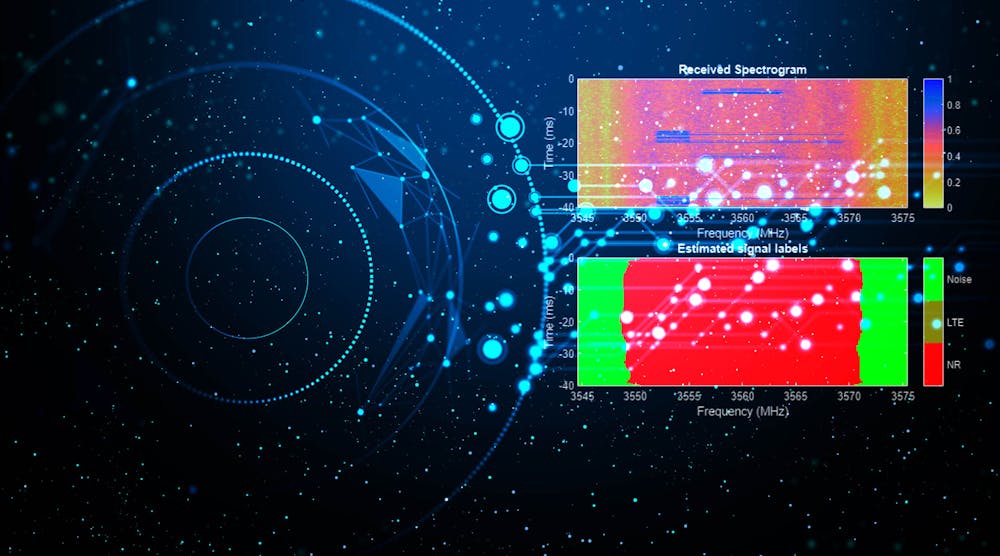
Deep learning has emerged as a powerful tool for enhancing spectrum sensing capabilities, providing a promising approach for improving the efficiency, robustness, and adaptability of spectrum allocation in wireless networks. As deep learning research continues to advance, we can expect to see even more innovative and effective applications of deep learning in spectrum sensing.
Introduction
Spectrum sensing is the process of identifying and classifying unused spectrum bands for efficient and effective allocation to wireless communication systems. This process is crucial for maximizing spectrum utilization and ensuring optimal performance in wireless networks. Traditional spectrum sensing techniques often rely on hand-crafted features and machine learning algorithms, which can be limited in their ability to accurately identify and classify spectrum usage patterns. Deep learning has emerged as a powerful tool for enhancing spectrum sensing capabilities, offering several advantages over traditional methods.
Deep Learning for Spectrum Sensing
Deep learning is a subfield of machine learning that utilizes artificial neural networks to learn complex patterns and relationships in data. These neural networks consist of multiple layers of interconnected nodes, allowing them to extract intricate features from raw data and make accurate predictions. Deep learning has shown tremendous promise in spectrum sensing, enabling the development of more sophisticated and robust algorithms for identifying and classifying spectrum usage.
The Architecture of Deep Learning Models for Spectrum Sensing
Deep learning models for spectrum sensing typically consist of the following layers:
- Input Layer: This layer receives the input data, which is typically a representation of the spectrum in the form of a time-frequency matrix or a set of frequency snapshots.
- Convolutional Layers: These layers apply convolutional filters to the input data. Convolutional filters are small, rectangular arrays of weights that are slid across the input data. The output of each convolutional filter is a feature map that represents the activation of the filter at each position in the input data.
- Pooling Layers: These layers reduce the dimensionality of the feature maps. Pooling layers typically use a max-pooling or average-pooling operation. Max-pooling selects the maximum value in a subregion of the feature map, and average-pooling averages the values in a subregion of the feature map.
- Fully Connected Layers: These layers connect all of the neurons in one layer to all of the neurons in the next layer. Fully connected layers are typically used for classification.
Training Deep Learning Models for Spectrum Sensing
Deep learning models for spectrum sensing are trained on a large dataset of labeled data. The labeled data consists of pairs of spectrum snapshots and their corresponding labels, which indicate the occupied or unused status of the spectrum. The model is trained to minimize the error between its predictions and the ground truth labels.
Advantages of Deep Learning for Spectrum Sensing
Deep learning offers several advantages for spectrum sensing, including:
- High Accuracy: Deep learning models can achieve high accuracy in identifying and classifying spectrum usage patterns, even in challenging environments with complex interference.
- Robustness: Deep learning models are relatively robust to changes in the environment and the presence of noise, making them suitable for real-world deployments.
- Adaptability: Deep learning models can be adapted to new spectrum patterns and usage scenarios by retraining them with updated data.
Applications of Deep Learning in Spectrum Sensing
Deep learning is being applied to a wide range of spectrum sensing applications, including:
- Cognitive Radio Networks: Deep learning algorithms are being used to dynamically identify and utilize unused spectrum bands in cognitive radio networks, enabling efficient and flexible spectrum sharing.
- Spectrum Monitoring and Enforcement: Deep learning-based spectrum monitoring systems are being developed to detect and analyze spectrum usage patterns, ensuring compliance with regulations and preventing unauthorized spectrum access.
- Dynamic Spectrum Allocation: Deep learning algorithms are being employed to optimize spectrum allocation strategies in wireless networks, maximizing spectral efficiency and minimizing interference.
Future Directions of Spectrum Sensing with Deep Learning
The field of spectrum sensing with deep learning is rapidly evolving, with ongoing research focused on:
- Hybrid Approaches: Combining deep learning with traditional spectrum sensing techniques to enhance overall performance and robustness.
- Real-time Spectrum Sensing: Developing deep learning algorithms that can perform spectrum sensing in real time, enabling dynamic and adaptive spectrum allocation.
- Spectrum Data Fusion: Integrating deep learning with other data sources, such as device location information, to improve spectrum sensing accuracy and coverage.